Who Is Tge Nhl Offical in Ny That Makes the Review Calls
TORONTO - It's a Fri evening in the Center of the Hockey Universe and thousands of Maple Leafs fans are streaming into Gate one at Scotiabank Loonshit. They gab and laugh, weaving through a tight hallway. It's nearly go time for a St. Patrick'south Day weekend matchup against the Flyers.
Next door, on the 10th floor of 50 Bay Street, home of the National Hockey League offices, Sean Ellis settles in for the night. Four TV monitors, a laptop, an iPad, an iPhone, a TV remote, a computer mouse, a canteen of h2o, a sandwich, and a assistant are all within attain. Like five other days this week and every week during the season, Ellis is in his element.
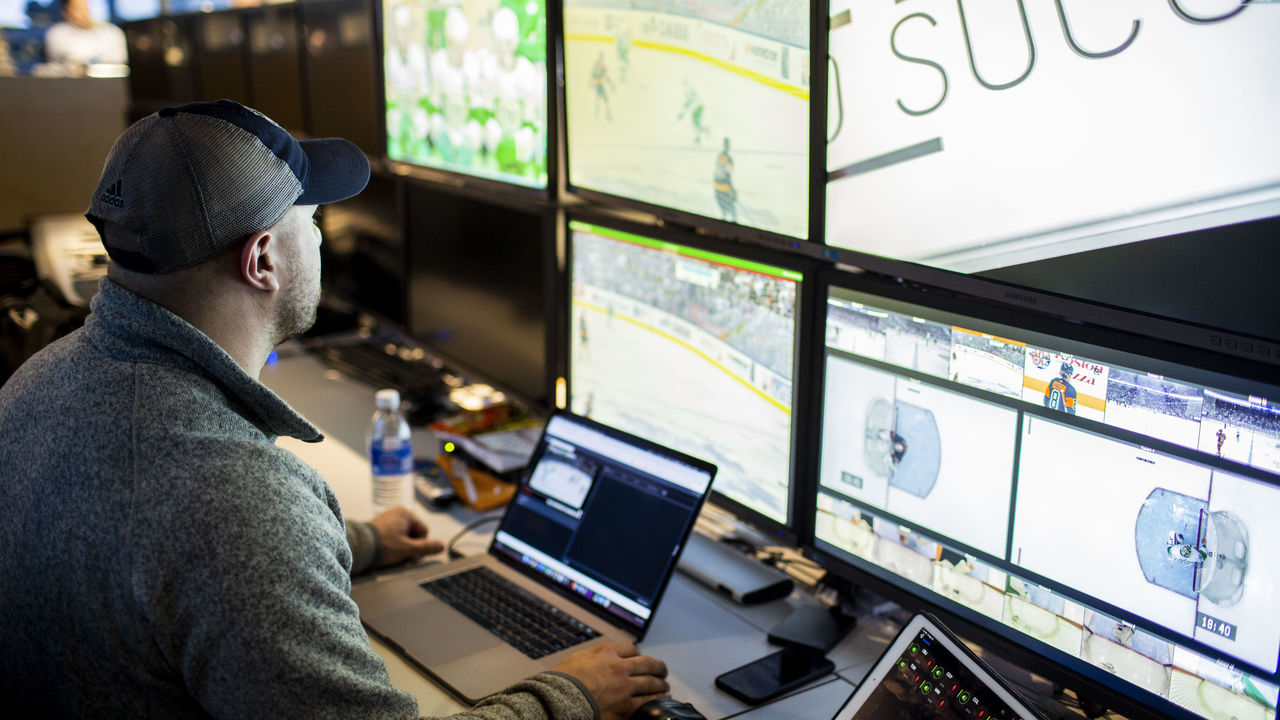
This is the workstation of a professional person hockey watcher. "I couldn't think of a amend job for myself," says Ellis, who's wearing an NHL-themed Patagonia sweater and a Wintertime Classic ball cap as he sits in his estimator chair, his back to a view of the Toronto waterfront.
Pro hockey was the dream when Ellis, who hails from Massachusetts, graduated from Amherst College in 2007. He dressed for five preseason games in the Primal Hockey League, hit the waiver wire, and decided to turn the page. "It was pretty disappointing," the 35-year-former admits. " ... But if it meant I wouldn't have this job, I'd cull this every time."
A decade later, Ellis holds the title of senior manager of hockey operations for the NHL. He'due south a key member of a grouping that, amongst other duties, audits games in existent time from the State of affairs Room, the league's eye for quality control.
Not to be confused with the Department of Player Safety - the NHL's New York-based disciplinary arm - the Situation Room reviews disputed on-water ice events such as goals, offsides, and goalie interference. Ellis and his colleagues are responsible for treatment coach's challenges and, in general, maintaining the integrity of the game.
On March 15, every bit the Leafs and Flyers skated earlier 19,290 fans a brusque walk away, the NHL granted theScore entry into the Situation Room. Here's what nosotros learned from our trip behind the scenes.
__________
The Situation Room traces its origins dorsum to an angry phone call from Ken The netherlands in 2002. The longtime Red Wings general managing director rang the league in the middle of a Wings-Flames game to vent nigh a gaffe by the on-site goal estimate in Calgary.
"You guys have to do something about this! This is wrong!" Holland said, as retold past Mike Murphy, the NHL's senior vice president of hockey operations. "We can't take amateurs and part-time people making calls on those games!"
At the next GM meetings, the idea of creating a centralized video room was tabled. That discussion eventually led the NHL to grant select employees last authority on plays that were deemed reviewable. Starting in 2003, all concerns were directed to a defended unit of professionals in Toronto, rather than a local part-timer who had the emotionally involved parties - like The netherlands and his GM peers, along with coaches, players, and fans - breathing down their cervix.
"This room's in a bubble. You're insulated from that type of abuse and that blazon of trouble. At the rink you can become influenced by the force per unit area of the crowd, the pressure of the full general managing director," Murphy says with the start of the Leafs-Flyers broadcast in his peripheral vision. "That was the creation of this, and information technology's simply exploded with more engineering. TiVo, loftier-definition TV, fiber eyes … "
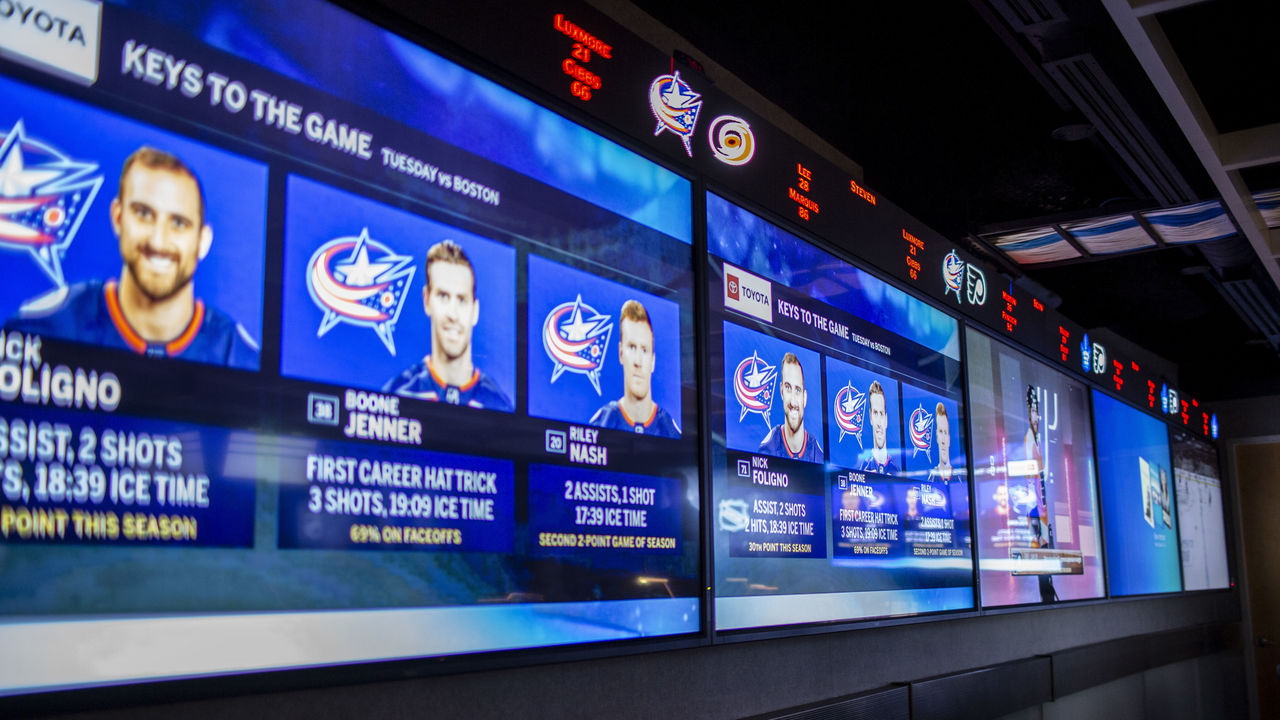
On this item nighttime, Irish potato and VP of hockey ops Rod Pasma man the bridge, an elevated strip inside the Situation Room. Five 90-inch screens are mounted at the head of the room. Above those screens, a ticker displays the operators and on-ice officials assigned to each agile game. Monitors on a side wall ensure in that location's no shortage of visual aids.
On either side of the bridge sit the video room operators, part- and full-time NHL employees who inspect games. The operators have instant access to xiv camera angles, some of which are sectional to the Situation Room, and they're trained to follow what other people aren't watching.
Ellis' spot is in the back row, a few seats away from Don Van Massenhoven. The longtime referee is part of a rotation of retired officials added to the group this flavor to supplement the review process. Their expertise lends a unique perspective and an extra layer of insight.
At around vii:35 p.m., with the Leafs and Flyers tied 1-1, the room comes alive.
Auston Matthews has batted a puck past Flyers goalie Brian Elliott in the final minute of the first period. On the water ice, information technology's called a goal by head ref Dean Morton.
"Oh!" Pasma yells. "The net's off," Ellis says calmly, defining the upshot. "Is it actually?" Tater asks. "Before it goes in?"
Inside seconds, Pasma initiates review protocol, sending a signal to the off-ice official stationed between the penalty boxes within Scotiabank Arena. A ruby strobe light flashes at water ice level and a man picks up the phone. "Hey Luke, it looks like we might accept a net off hither … "
As Pasma, Spud, and Van Massenhoven picket the sequence from numerous angles, Ellis transfers footage of the play to an iPad that tin can exist viewed by the referees inside the arena. Morton picks up the tablet, puts on a headset, and links upwards with Pasma for a chat.
"Whaddaya got, Morty?" Pasma asks.
"We've got a good goal. Matthews bats the puck … (The Flyers are) talking about the internet beingness off. I don't have the net moving at all until maybe later the play? And it looked like it was in play even when Matthews was batting away at the side of the net."
"Yeah. From where yous are, Morty, information technology's hard to encounter considering Elliott'south pad's on it, only this net is definitely off the moorings before he shoots it in. OK? And so, the internet is off. This is no goal, Morty."
"And then, we've got no goal. It wasn't continuous action and the Flyers did non bat it in?"
"That's exactly right. We looked at that, too, Morty. He shoots it well after the net'south off."
"OK, so we've got no goal. The internet was off its moorings prior to the puck crossing the line. OK, thanks."
Headset off, Morton delivers the verdict to the Toronto crowd. Matthews rolls his optics. As a chorus of boos drowns out Morton'due south last words and social media reacts to the decision, the Situation Room launches into Phase 2: educating the hockey earth.
The league'southward communications and public relations departments accept been involved in the review process to varying degrees since the 2009 playoffs. In the moments following the Matthews decision, Corey Dempsey, an in-game communications employee, has already typed a rough typhoon laying out the Situation Room'south reasoning for overturning the call on the ice.
PR colleague Trevor Bjergso consults with Dempsey, who has a Give-and-take doc open for Pasma'southward approving. Making his manner over from the span, Pasma recites exact diction for one particular part of the draft. The linguistic communication is important. Dempsey reads the passage back to Bjergso, Pasma, and Spud. He gets the light-green calorie-free from his superiors. It's ready for public consumption.
The explanation is emailed to the PR departments for the Leafs and Flyers, as well as regional and national dissemination partners. Roughly ten minutes after Pasma'due south headset discussion with Morton, the rationale is published on NHL.com and fed through the league's social media channels. "The room's evolved," Pasma says, "into this existent-time information generator."
White potato connects via telephone with his dominate, executive VP of hockey ops Colin Campbell, who is working from his home in the southwestern Ontario farm town of Tillsonburg. In great item, they discuss a potential issue with the nets in the Leafs' home rink. Toronto was on the wrong side of another goal review earlier in the week, and in both instances, the net seemed to be rather easily dislodged.
Pasma joins the chat and the three higher-ups toss effectually several theories. Nothing official is existence decided, but there's a potent sense of marvel. They'd like to be proactive. So, what's really going on? Are the pegs used to secure the nets not gripping the ice? Is this actually an issue? If then, how can information technology exist fixed?
This back-and-forth is a prime example of the Situation Room's influence on the game of hockey, which extends far beyond a goal review on a Friday night in mid-March. In the moment, the group is beholden to the rule book and errs on the side of caution. In that location are no articulatio genus-wiggle reactions. However, the room often serves as a think tank for improving the on-ice product.
"Snow gets in there and either messes with the integrity of the peg or keeps it from going down. Something. When our water ice crews go out, clean the holes out, put the pegs dorsum in," Pasma says to Campbell and Spud at i point. The pair conspicuously agreed. On Sabbatum, the hockey ops section emails a memo to arena crews across the league, encouraging them to pay closer attention to the stability of the nets.
Much like the dynamic within the State of affairs Room itself, the NHL'south hockey ops department tries its all-time to operate democratically over the medium and long terms. The GMs, on the whole, act as the State of affairs Room'southward "compass," Pasma says, but the line of advice is always open.
"A lot of times, if we take a lot of contentious plays, we'll take them to the managers meetings," he continues, emphasizing the collaborative approach of the NHL's major off-ice influencers. "Hither's the play, hither's our ruling on information technology, here's why we ruled on information technology, tin you tell the states what you lot guys call back?"
__________
There was a fourth dimension when the NHL's hockey ops department simply ruled on histrion safety problems, handing down suspensions for biting, spearing, and other egregious acts. Murphy, the 68-year-one-time former player and coach, laughs when he remembers attempting to review footage on the fly with 12-inch TVs and VHS tapes.
"If you saw something, you'd accept to expect for a commercial suspension and then bustle dorsum to the right spot (in the tape)," he says, recalling having to FedEx the cassettes to Campbell's dwelling house. "Then you lot'd hurry forward to reset information technology so you wouldn't miss the game."
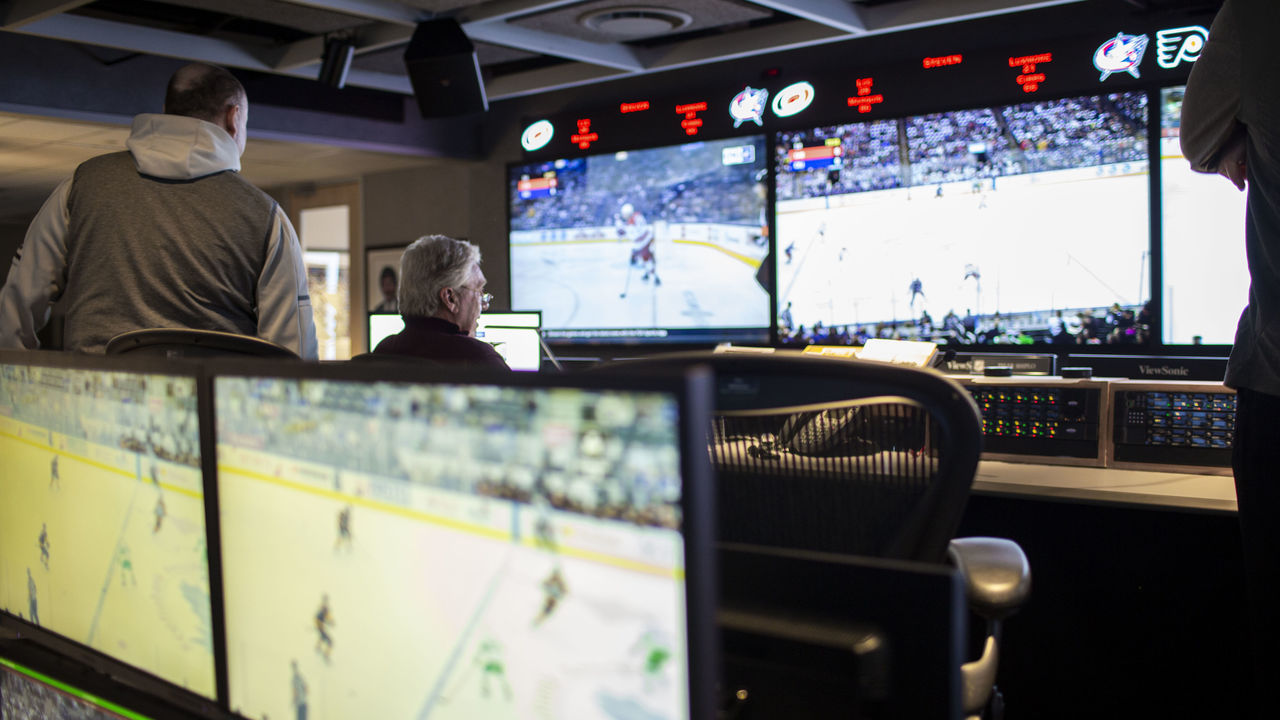
In 2019, the player safety department and the State of affairs Room operate completely independently from each other, and the latter's considered innovative in the pro sports landscape. Of course, it helps that the technology has improved immensely, solidifying and streamlining the review process.
Next season, role player and puck tracking volition be rolled out on a total-time basis, adding a new tool to the technological armory. Will information technology dramatically touch on the Situation Room? As of now, it's tough to say.
"There are times where nosotros lose a puck in the goalie'southward equipment - under a pad - and you think it may be in the net only you lot can't be 100 pct sure. Or information technology goes into his glove and you think it's across the goal line. I think tracking may help in that area," Pasma says. He also thinks it could, hypothetically, help in the realm of high-stick goals too.
But at that place are no guarantees with new tech. And for the Situation Room's inhabitants, that's part of the fun. The NHL's rules will forever be tweaked, its production quality ever improved, yet the group'southward collective dedication to "getting it right" simply cannot slip.
On this particular Friday night, Ellis hops into his car well later midnight following a second game plus some additional Situation Room duties. With Leafs fans long gone from Scotiabank Arena and the weekend's Irish-themed festivities in full swing, the professional person hockey watcher drives some 100 kilometers to his home in Cambridge, Ontario. He'll complete the aforementioned commute again and again and over again, logging more than than 400 games a year.
Not a bad gig for a guy who couldn't scissure the Central Hockey League.
"At times, similar in February and March, it can actually feel like it's dragging. But you but need one game where something big happens and you snap out of information technology," Ellis says. "You lot walk abroad at the end of the nighttime and remember how lucky you are to become to practice this."
John Matisz is theScore's National Hockey Writer. You tin can find him on Twitter @matiszjohn.
Source: https://www.thescore.com/nhl/news/1733144
0 Response to "Who Is Tge Nhl Offical in Ny That Makes the Review Calls"
إرسال تعليق